
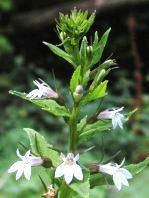
 Indian Tobacco
Some readers will be surprised by our endorsement of any herb that is to be smoked; especially one that is called a "tobacco". We endorse the medicinal use of Indian tobacco (lobelia inflata). Smoking truly natural substances is not necessarily harmful. Even real tobacco does not need to be dangerous, but it is made dangerous by the industry. Commercially-made cigarettes are harmful because of the additives, the glues, the radioactive fertilizers, and the papers that are used -- not the tobaccos themselves. The American Indians smoked organic tobacco for a thousand years before the Europeans arrived, without cancers. They get cancers now, for the same chemical reasons that everyone else is getting cancers.
Both the seeds and the dried leaves of Indian tobacco contain alkaloids which yield its effects. Indian tobacco is mostly used for its beneficial effects upon the lungs, although it is also believed to boost the overall immune system. It has the unusual property of being a stimulant to the respiratory system, whilst being a general relaxant for the rest of the body. It has been found to be very helpful for asthmatics, with some asthma sufferers substituting it for their inhalers.
Indian tobacco has been traditionally used to effectively suppress common colds, bronchitis, and pneumonia. The smoke from Indian tobacco reduces phlegm, and kills infections in the lungs. It thins mucus, which increases recovery time, and causes many infections to be less symptomatic. When people use it for this purpose, it is often smoked with the herb mullein. Mullein was once used to soothe the coughing associated with tuberculosis, and to cure it. Mullein has no "flavor", and is a very light smoke. Most people feel like they are breathing pure air when smoking mullein. It therefore makes a good base to mix Indian tobacco with. The two tend to work well together to amplify the benefits of each.
Indian tobacco has been used by many people who were trying to quit smoking, but it was banned in such products in 1993 by the F.D.A, even though the agency had no legitimate jurisdiction. The agency claimed that Indian tobacco was ineffective. The F.D.A. did not bother to fund any studies to test its effectiveness at all; which leads us to conclude that the ban was to protect both the pharmaceutical industry and the tobacco industry. Americans can still freely buy Indian tobacco, but sellers are not allowed to inform people that it greatly helps with smoking cessation or of its medicinal benefits.
One of its constituents, isolobelanine, helps to relax people whenever they are experiencing stimulant withdrawal symptoms, which includes nicotine withdrawal. Indian tobacco contains lobeline too, an alkaloid that helps to clean the lungs. When a person's lungs are clean, smoking becomes disagreeable, causing the smoker to become dizzy or nauseous, like when they first began smoking. This will generally aid someone who is trying to quit smoking, by serving as a deterrent. Studies have widely-varying results regarding the benefits of Indian tobacco, but most of the negative studies were illegitimate, because they used orally-consumed extracts that had been chemically altered. It exemplifies the sort of data shopping that the F.D.A. routinely conducts to get the 'right' research results.
Researchers have been studying the effects of Indian tobacco on amphetamine addictions. Lobeline counteracts excessive dopamine, which occurs in people suffering from methamphetamine addiction. Some people have successfully used it to treat alcoholism. Studies on rats have shown that one of the active constituents in Indian tobacco actually improves the memory of rats, even 24 hours after its usage.
Indian tobacco was historically smoked, but people have begun swallowing the dried leaves and making herbal teas from it, in recent times. The newer methods of oral consumption are unwise, even though they are ironically intended to make it safer. For those who decide to use Indian tobacco medicinally, we strongly recommend smoking it via a pipe, instead of ingesting it. This is because the dosage is extremely important, and people have a tendency to overdose with ingestion. Large amounts will induce vomiting, so smoke only a pinch, and use more if needed. Dizziness is an early symptom that too much has been used, and the person could become ill if it is continued after that. Old herbalist books refer to Indian tobacco as "pukeweed".
Do not use Indian tobacco alongside pharmaceuticals, because it has a tendency to interact with drugs. It especially amplifies the effects of medications that are given to control blood pressure, but it counteracts drugs given to control diabetes. It increases the loss of potassium from the body if it is taken alongside diuretics or corticosteroids. Aspirin and NSAIDs may increase the risk of overdose reactions to lobelia, leading to vomiting and other illness symptoms.
Taurine supplementation has been shown to reverse much of the damage caused by smoking (tobacco), even when smokers continue to smoke during treatment. A 2003 study found that damage caused by chronic smoking can be reversed in as little as five days with a dosage of 1.5 grams of taurine. The inner lining of the blood vessels, and the diameter of blood vessels returned to normal in the study.
Purchasing Indian Tobacco
Sellers of this herb often refer to it by its botanical name, lobelia inflata, instead of Indian tobacco. This is because they are avoiding the stigma and regulations that are associated with tobacco products. Searching for the plant by its botanical name will make sellers easier to locate.
Sources
Vitamin C, taurine, and allopurinol reverse endothelial dysfunction in smokers, Medscape
Two weeks taurine supplementation reverses endothelial dysfunction in young male type 1 diabetics, Diabetes & Vascular Disease Research
Effects of lobeline, a nicotinic receptor agonist, on learning and memory., Journal of Pharmacology, Biochemistry, and Behavior
Related Articles
Fire Safe Cigarettes and the Genocide Against Smokers
Quick Tip: Eliminating Coughing and Lung Inflammation