
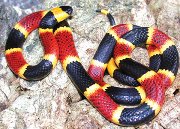
 Coral snakes are the most venomous in the U.S.A. Remember: "If red meets yellow, kill a fellow".
Snake bites can be very dangerous, and we recommend immediately seeking emergency medical care, if it is available. Hospitals are the only source for getting antivenin. However, there are scenarios when emergency medical assistance is hours or even days away. This article catalogs some treatments that can help in these situations.
Apply dampened activated charcoal to snake bite fang wounds as soon as possible. With some snake bites, making a small slit in the fang lesions is necessary, while other bites leave large enough holes for the activated charcoal to absorb well. Use a band-aid, cotton with medical tape, or anything else that is available to firmly hold the dampened charcoal onto the wound. Check periodically, and re-dampen the charcoal if it has dried. Do not use DMSO to increase absorption, for it will cause the venom to sink deeper into the body.
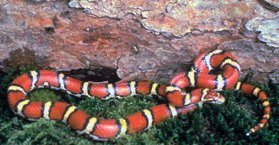 Milk snakes ('fake coral snakes') are not poisonous. Remember: "If red meets black, a friend to Jack".
Next, take at least 2 teaspoons of dampened activated charcoal powder internally. Make certain to dampen the charcoal first, because it can cause havoc for the lungs if you inhale the dust.
We found that there are varying results in the use of tourniquets. The medical establishment is preaching to never use them nowadays, and we likewise acknowledge that there are inherent dangers in using them. As such, it is necessary for people to use their best judgment in deciding whether a tourniquet should be applied. Tourniquets can lead to the loss of a limb, but this is an acceptable risk in some instances. If you decide to use a tourniquet, you should write "TK" and the time on the victim's forehead, so medics will know how long it has been applied, in case you get separated or injured yourself.
Some people use a tourniquet that is just tight enough to slow the circulation, instead of entirely stopping it. This method is designed to allow treatments to take effect before the venom spreads throughout the body. If done correctly, it eliminates the risks associated with tourniquets.
|
Echinacea oil is known to help neutralize snake bites. This property of echinacea was first discovered by the American Indians. In addition, echinacea boosts the immune system, and thus helps to fight infections. In the event of a snake bite, we strongly recommend taking a large dose of echinacea supplements, and repeating every 6 hours. If swallowing is difficult, then hold it in the mouth for as long as possible for blood absorption through the cheeks and tongue, before attempting to swallow. This technique is recommended for the charcoal consumption too. Get these supplies ready beforehand, because it is too late to go shopping during a poison emergency. Only purchase echinacea from herbal or health food stores, due to supplement quality issues. Please read the article about activated charcoal for safety and preparation instructions.
After the first 24 hours, activated charcoal will be largely ineffective. You may wish to apply moistened bentonite clay topically during this time. Bentonite clay is known to remove toxins, and is also advised for treating spider bites. For best results, mix echinacea powder with the bentonite clay and water. Apply this paste to the wound. You may simply open echinacea supplement capsules to obtain the powder. As with the activated charcoal and the echinacea, have the bentonite clay ready beforehand. Bentonite clay is not found in most retailers, and it must usually be purchased online, so get it now.
Always remember to seek medical attention at the earliest opportunity, because snake bite victims should get an antivenin as soon as possible. These techniques are virtually guaranteed to help a victim, but they may not be enough to save a person from a fatal snake bite.
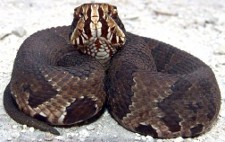
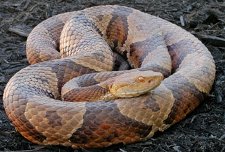
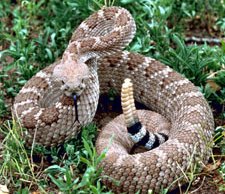
There are four types of poisonous snakes in the United States, and they all tend to be temperamental, despite what the new-age nature lovers would have us believe. These vicious monsters include the copperhead, cottonmouth, rattlesnake, and the coral snake. It is important to be able to recognize the different types of poisonous snakes, so that you can get the best medical treatment. Being treated with the wrong type of antivenin can be fatal. Study the images in this article carefully. If possible, it is best to kill the snake, and then take it with you to the hospital, in order to get a verified identification of its species. The snake's head should be severed, in order to be certain that it is dead. Be cautious of the fangs, which could convulse at any time to inject venom.
Related Links
Audio Report: Our Radio Show Appearance On Buckshot's Survival Hour
Naturally Treating Brown Recluse Spider Bites