
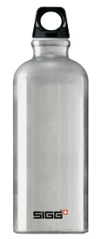
 This "safe" Sigg brand drinking bottle (sold at Whole Food's Market) is not as safe as we were led to believe.
In a small victory for consumers, BPA-free water bottles have found their way into regular grocery stores. Researchers and the public already know the dangers of BPA, despite the refusal of the F.D.A. to acknowledge them. However, the new water bottles may not be as safe as people assume. While they may not leach the hormone-destroying bisphenol-A (BPA), a strong plastic taste can still be noticed in water stored in the new generation of bottles.
The chemicals that leach out of plastics are always harmful to health. Oftentimes these chemicals go unnoticed because flavored drinks can mask the chemical taste. As a rule of thumb, plastics should be categorically avoided for food and beverage containers. All plastics leach, but they leach different chemicals at varying levels. Therefore, some plastics may be safer than others, but none are completely safe. The plastics used to make milk jugs are fairly safe. Clear plastics, like those used for soft drinks, are the worst.
Those who realize the dangers of plastic bottles will usually use metal containers. Unfortunately, manufacturers are using extremely dirty marketing tactics to continue poisoning us. A major design problem was found with the cheap aluminum containers, and a more insidious remedy was employed. The problem was that common aluminum drinking bottles normally react with acidic drinks (all popular soft drinks), to cause the drinks to become toxic with heavy metal compounds, whilst the containers themselves decay from the acids. Instead of switching to a non-toxic, more resilient metal like stainless steel; the manufacturers secretly began lining aluminum drink cans with clear plastic, like the clear coats that are used on automobiles.
Most of the safe metal water bottles are essentially plastic bottles in disguise. While no mention of this is found on the labels, manufacturers have an incredible tendency to boast about the plastic linings on their websites:
"A baked on inner-lining which meets F.D.A. requirements, doesn't impart odors or tastes."
"Contains a strong, taste-neutral bpa-free plastic lining."
"This eco-friendly bottle has a special leach-proof lining."
These companies completely disregard that the primary reason for the purchase of metal bottles is because people do not want plastic. Manufacturers are charging consumers four times the amount that they would charge for a plastic bottle of the same size. They trick customers into buying plastic containers, when customers are specifically attempting to avoid them. The scam is perpetrated by simply adding an aluminum outer layer over the plastic interior, which exists for deception only.
Sigg Brand Bottles
Sigg, a brand which is proudly made in Switzerland, is one of the companies that deceives consumers with this method. In fact, Sigg boasts that they use a "proprietary" lining, which means that they go to special efforts to hide which plastics are used. We paid particular attention to this company, because it is the brand being sold in Whole Food's Market. It is a store that most people feel is safe for finding non-toxic merchandise, but unfortunately, this seems to be changing fast.
Related Articles
Sanitary Tampons and Pads: How Their Dioxins Are Leading To The Endometriosis Epidemic
Soy is Unfit for Human Consumption
Why We Bought A Bread Maker, and Why You Definitely Should Too
Juicing: The Hormone Regulator
How Some Gyms Are Very Dangerous To Health and How They Might Even Eventually Kill You